














A383.0 (ADC12 Modified) Comprehensive Guide to Die-Cast Aluminum Alloys: Composition Optimization, Performance Benefits and Selection Strategies
Date: 2026-02-01 Categories: Blog Views: 143
As the American ASTM standard “Easy-to-machine” die-cast aluminum alloys the paradigm of theA383.0 by means ofSuperior castability, excellent dimensional stability and industry-leading machinabilityAnd famous for it. The alloy is essentially an optimized version of the classic alloy A380.0, byAdjustment of silicon and copper content and strict control of iron and zinc ratioThe new product, while maintaining good mechanical properties, significantly improves thin-wall filling capacity and subsequent processing efficiency, and is the perfect solution for the production ofHigh-volume die castings requiring extensive drilling, tapping or complex machiningIdeal for.
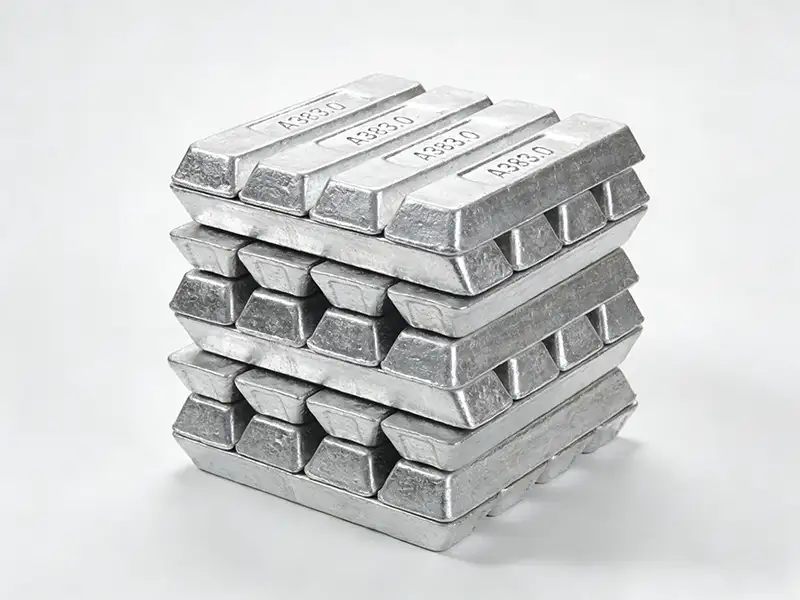
A383.0 Corresponding Standards and Grades
- ASTM Standard Grades: According to the American Standard ASTM B85, the grades are?A383.0.
- Grade Meaning: belongs to the A3xx.x series (silicon based) and is a “derivative” or “improvement” of A380.0.
- Core features: Compared to the A380.0, the A383.0'sLower copper content and better silicon morphology (usually metamorphosed)This brings us directly to theBetter processability, corrosion resistance and casting fluidity.
A383.0 Aluminum Alloy Composition Table (based on ASTM B85 typical requirements)
| elemental | Content range (wt%) | functional role |
|---|---|---|
| Silicon (Si) | 9.5-11.5 | core elementIt provides excellent flowability. Grain refinement and improved processability are often achieved through densification. |
| Copper (Cu) | 2.0-3.0 | Enhanced ElementsThe content of A380.0 is lower than A380.0, which ensures strength while reducing adhesion and corrosion on cutting tools. |
| Iron (Fe) | ≤ 1.30 | Prevents sticking to the mold, but too much iron can form hard spots and accelerate tool wear, so it needs to be controlled. |
| Zinc (Zn) | ≤ 1.00 | impurities, A383.0 typically requires a lower zinc content than A380.0 to further enhance corrosion resistance. |
| Manganese (Mn) | ≤ 0.50 | Neutralizes the harmful effects of iron. |
| Magnesium (Mg) | ≤ 0.10 | Trace, impurities. |
| Nickel (Ni) | ≤ 0.50 | Available. |
| Tin (Sn) | ≤ 0.15 | Impurities, strictly controlled. |
| Aluminum (Al) | tolerance (i.e. allowed error) | Substrate material. |
A383.0 Physical and Mechanical Properties Parameter Table (die-cast state, typical values)
| Performance indicators | Numerical range | Comparative Analysis (vs A380.0) & Core Benefits |
|---|---|---|
| intensity | 2.74 g/cm3 | Slightly lower than A380.0. |
| Tensile strength (Rm) | 310-330 MPa | Equivalent to A380.0The high strength structural component requirements are fully met. |
| Yield strength (Rp0.2) | 150-160 MPa | Comparable to A380.0. |
| Elongation (A) | 3.0-4.0% | Significantly better than A380.0 (~2%)The toughness is better. |
| Brinell hardness (HB) | 75-85 | Comparable to A380.0. |
| Machinability Index | 80-85 (based on A380.0 at 70) | Core Advantages: Tool life can be extended by 20-40% and machined surface finish is higher. |
| Casting mobility | talented | Superior to A380.0, easier to fill complex thin-walled structures. |
| corrosion resistance | favorable | Better than A380.0, thanks to lower copper and zinc content. |
Performance features and design concept
A383.0 was designed with the idea that the “Designed for Manufacturing” It fully optimizes the entire production chain from die casting to post-processing:
- Excellent machinability: ByReduction of copper content, optimization of silicon phase morphology (densification) and control of harmful elements (e.g. Fe, Zn)It greatly reduces abrasive wear and chemical corrosion of the tool during machining, reduces machining costs and improves productivity.
- Better casting performance: Slightly higher silicon content and optimized composition allow for better flow than A380.0, enabling the production of more complex, thinner-walled parts, enhancing design freedom and product qualification.
- Good overall performanceThe strength and hardness are on par with A380.0, while the toughness and corrosion resistance have been improved.
Corresponding international grades
As a widely used optimization alloy, its international counterpart is well defined:
- American Standard:A383.0?(ASTM B85)
- Chinese national standard: Closest composition to performance?YL113 (YZAlSi11Cu3)However, the cutability of YL113 is usually not specifically optimized as a core metric.
- Japanese Standard:: In conjunction with the?ADC12?Very close and can be considered a highly processable version of the ADC12.
- EU standard:EN AC-46200?(EN 1706)
- Canadian Standard:S12C?(CSA)
A383.0 in the die casting industry
based on its “High strength and easy to work with.” With its unique labeling, A383.0 is widely used for complex parts that require extensive secondary machining:
- Intensive machined housings (core applications)
- Engines and Drivetrains: Transmission valve body, fuel distributor housing, engine oil pump body (covered with fuel lines and mounting holes).
- Hydraulic and pneumatic systems: Multi-way valve blocks, cylinder end caps, hydraulic pump housings (high-precision hole systems and threads required).
- Compressor housings: Complex internal structure with multiple chambers and interfaces to be machined.
- Complex thin-walled structural parts
- Electronic equipment housings: Server racks, network switch housings, large connector housings (both strength, complex internal structure and machined holes).
- power tool: Gearbox housings for high power drills and angle grinders.
- Auto Parts
- braking system: ABS module housing, brake caliper related parts.
- steering system: Housing for electric power steering (EPS) systems.
A383.0 Aluminum Alloy Frequently Asked Questions
Q1: What is the biggest advantage of A383.0 over A380.0?
- The overwhelming advantage is “machinability”.”. Using A383.0 it is possible toSignificantly extends tool life, reduces tool changes, increases machining speeds, and achieves better surface finishes.. For parts that require extensive drilling, milling, and tapping, the reduction in total production cost (material + processing) is often far greater than the small price difference in the material itself.
Q2: Can A383.0 be heat treated?
- Solid solution treatment like T6 is not usually performed or recommended.. Like most high-silicon die-cast aluminum alloys, it has internal porosity, and the high temperatures of the solution treatment tend to cause blistering on the surface of the casting. However, it can be subjected to?T5 manual aging(e.g. holding at 150-180°C for several hours), which can increase their yield strength and dimensional stability by a small margin without significantly increasing the risk of deformation.
Q3: What is the anodizing performance of A383.0?
- Better than A380.0, but not optimal. Since its copper content still reaches 2-3%, the anodized color will be grayish and darker, and the film uniformity will not be as good as lower copper alloys (such as A360.0 or ADC3). For high decorative requirements, thicker coatings or specific coloring processes may be required. For functional oxidization (e.g., increased wear and corrosion resistance), it performs well.
Q4: Under what circumstances should I choose A383.0 instead of A380.0?
- When a die casting meets the following conditions, it shall bePrioritize A383.0:
- High share of secondary processing costs in total costs(e.g., machining time over die casting time).
- partsComplex structure and thin wallsThe casting filler requirement is high.
- thorough analysis of the partToughness (elongation) and corrosion resistanceThere are slightly higher requirements.
- simple rule: If requiredworking (of machinery), choose A383.0; if the casting is essentially complete with little or no machining, choose A380.0.
Q5: What are the similarities and differences between A383.0 and ADC12?
- They're so similar, they're considered “sister alloys.”.. There is a high degree of overlap in composition and performance range between the two. The main differences are likely to beControl standards for trace elements (e.g. Zn, Sn)respond in singingWhether silicon phase densification is performed by defaultIn practice. In practice, many suppliers offer “high-quality ADC12s” that perform as well as the A383.0. In the selection, the key is to confirm with the supplier's materialStable achievement of A383.0 grade machinability indexes.